Posts tonen met het label mobile. Alle posts tonen

dinsdag 13 december 2016

Smartphones winnen aan belang voor E-commerce, blijkt uit de BeCommerce Market Monitor

De Belgische e-commerce blijft elk kwartaal aan belang winnen en groeide ook in het derde kwartaal van 2016 verder. Wij, Belgen, gaven bijna 2,2 miljard euro uit in de periode juli-september, een toename van 9 procent. Met 6,8 miljoen Belgen (73% van de bevolking) deden we 20,9 miljoen online aankopen!
"De groei van e-commerce in België is op zich niet verrassend, het is een trend die zich de afgelopen jaren duidelijk heeft doorgezet. De beschikbaarheid van Amazon in het Nederlands en de komst van typisch Amerikaanse initiatieven zoals Black Friday naar Europa zullen deze trend enkel versterken."

Smartphones winnen aan belang

Online winkelen gebeurt steeds vaker met de smartphone. 16 procent van de online shoppers heeft ten minste één mobiele aankoop gedaan in dezelfde periode. Hiermee haalt de smartphone ook de tablet in qua populaireit voor online shopping.
"Een belangrijke reden voor de toename van aankopen via de smartphone is het toenemende vertrouwen ten opzichte van de smartphone als winkel- en betaalmiddel: hoewel 1 op 2 Belgen betalen via een smartphone nog steeds als “niet veilig” bestempelt, merken we hier toch een vooruitgang."
"Wanneer we vooruit kijken naar de verwachtingen rond mobiel winkelen en betalen, verwachten we dat dit enkel zal toenemen: 4 op 10 Belgen is er van overtuigd dat betalen via de smartphone gemakkelijker is, terwijl 1 op 3 Belgen aangeeft vaker te willen betalen met de smartphone in het komende jaar."
Bron: Deze resultaten kunnen we afleiden uit cijfers van de BeCommerce Market Monitor, een onderzoek dat uitgevoerd wordt door GfK voor BeCommerce, met de steun van PostNL, Google en Worldline.

Meer info: www.gfk.com/shopping-in-belgium 
Originele post op LinkedIn

woensdag 3 februari 2016

Market Research Digitization part 3: the rise of mobile

The digitization of market research (and the society) has been a hot topic for a couple of years now: the year of mobile, the year of big data, the year of social ... we have had them all. Most organizations (and research agencies) have a digital department in some way.

All (digital) evolutions of marketing and market research are however triggered by a consumer trend. In this series of 4 posts, I will share my thoughts on the evolutions of the past years and the impact on market research. Today, we focus on the impact of mobile.

With smartphone and mobile internet penetration hitting 75% in Europe and the Americas (Source: ComScore), we arrived in the mobile era already some time ago. Mobile has often impact beyond obvious observations, for example on consumer shopper behavior. When shopping, consumers use their phones to compare prices, ask for advice or take pictures of products & advertisements (GfK global consumer survey, 2015).


Mobile did however not only change what the path to purchase looks like, but also what’s actually being spend: an average online shopper basket on a computer is worth about € 110, an average smartphone basket only contains a value of € 50 (GfK Belgium, BeCommerce Market Monitor, 2015). This device diversity has huge implications for the online strategy of retailers.

There are two stories to the mobile challenge for market research: on one hand, we need to face threats of research participants using their mobile for research, on the other hand we need to leverage mobile and seize the opportunities as good as possible. I will give an example of a mobile threat (survey respondent) and a mobile opportunity (location based research).

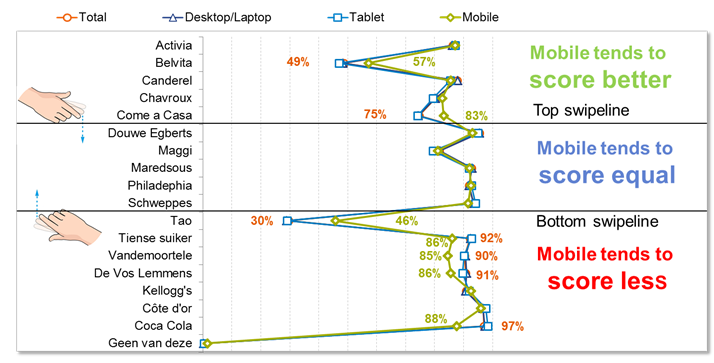
Survey research participation on mobile has impact on set-up, data collection, dropout rates, results ... An important threat is the swipe effect, which raises issues if answer options on a survey question (single or multiple choice) are not all visible on one screen ( i.e., one has to scroll or swipe down to see all the options).

Randomization of answer options might offer a solution to validate relative scores between the options (for example, Coca-cola is better known than Kellogg’s), but not for hard KPIs: Coca Cola aided awareness on computer hits 98%, while on mobile - if only visible after scrolling down, it drops to 88%. The contrary is true as well: top swipeline items tend to score better on mobile.


Source: GfK Belgium, n = 5444, 2014

Thinking mobile (first) and optimizing research for mobile should be any researcher’s concern nowadays. Survey research is only a part of it, it’s the part where we face the challenge of transforming our traditional approach to new devices used by participants. On the other hand, we can also leverage the power of mobile via "research on the go", "research in the moment", "mobile communities" or "location based research".

Researchers or clients often think about location based research in a complicated way (beacons, GPS ...), but one of the best use cases of location based research with mobile might just be TripAdvisor: from location feedback without mobile (evaluate us when you get home) to location based research leveraging the always connected consumer (a poster that says: "evaluate us now").

The mobile evolution: rate us when you get home VS rate us now

The mobile evolution triggers us into thinking mobile (first), but we should be careful to avoid thinking 'mobile only'. An omni-channel research experience, or a device-neutral set-up, should be the starting point.

In the last post of this series, I will dig deeper into the role of mobile in the device mix and the consequences of device switching behavior. For more information or an extended version, feel free to reach out!

vrijdag 21 augustus 2015

How my OPO represents the global smartphone market

This is my current smartphone. The OnePlus One, or OPO if you like. I have it for about 9 months, and it embodies the 4 major global smartphone trends of Q1 2015.

1. Bigger screens

With a 5.5" 1080p full HD screen, the OPO is without discussion a smartphone with a big screen. Some call it a phablet, some don't. The official minimum phablet size varies between 5" and 5.7". Globally, smartphones with big screens are driving the market growth.

2. The rise of 4G

Having a 4G (LTE) connection is no longer the exlusive right of € 500 + smartphones. Also mid- and low-budget smartphones allow you nowadays to be fully connected on the go. 50% of smartphones sold in Q1 2015 has 4G connectivity.

3. Cheaper handsets

The market of low-end smartphones grew in Q1 2015, the mid-range share remained stable. High-end smartphones lost market share because of this evolution. Low-end smartphones represent over 50% of the global market today.
This evolution is different in Belgium, where the mid-segment is under pressure. Find out more about the 3 Belgian smartphone trends [Dutch].
4. Fast growth of emerging markets

Emerging markets are not only driving the global market growth, but also disrupt the manufacturers' scene. Brands as Xiami, Huawei or Oneplus are no longer exlusive for the APAC region but offer their products worldwide. The markets in Middle East & Africa and emerging APAC are forecasted to grow by 29 to 33% in 2015.

Source: read the full GfK Smartphone market trend report.